As industrial AI moves closer to machines, vehicles and frontline operations, the challenge is no longer simply how much AI computing power a single device can provide. A more important question is how different endpoints, computing nodes, local data and cloud models can work together as one intelligent system.
Ailyn provides an architecture for connecting these distributed resources. Rather than treating AI as a standalone cloud service, it enables local devices, computing platforms and cloud capabilities to participate in the same task workflow.
For industrial computing applications, this creates a path toward more flexible edge AI deployment, where workloads can be processed close to the data source while additional computing or model capabilities remain available when needed.
Why Industrial AI Needs More Than a Single AI PC
A standalone AI PC can provide powerful local inference, but many industrial workflows involve multiple systems at the same time.
A factory may include industrial PCs, operator terminals, cameras, sensors, servers and enterprise systems. A warehouse may combine handheld terminals, vehicle-mounted computers, WMS platforms and local data storage. Transportation environments may require vehicle computers, positioning systems, communication modules and remote management platforms.
The value of industrial edge AI therefore depends not only on the performance of one processor, but also on whether these computing resources can exchange data and coordinate tasks efficiently.
Emdoor IPC provides multiple
industrial PC platforms
that can serve as local computing nodes for automation, data acquisition and edge applications.
The goal is not simply to put AI on every device. It is to allow the right device, model and computing resource to participate in a task at the right time.
On-Device Processing for Faster Industrial Response
One of Ailyn’s core principles is to prioritize local processing when appropriate.
For industrial environments, local execution can provide several practical advantages. Data does not always need to travel to a remote cloud before a response can be generated, reducing unnecessary communication delay and allowing selected workflows to remain available even when network conditions are limited.
Typical local tasks may include data preprocessing, image analysis, status recognition, document retrieval, equipment interaction and other latency-sensitive workloads.
This concept aligns naturally with
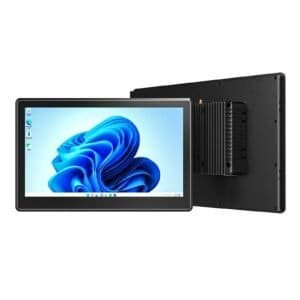
industrial panel PCs,
which combine local computing, touch interaction and industrial interfaces within one integrated platform.
Multi-Device Collaboration Across Industrial Endpoints
Industrial workflows rarely stay on one endpoint.
A task may begin on an operator terminal, retrieve information from local storage, use another compute node for AI inference, and then return the result to a mobile or vehicle-mounted device.
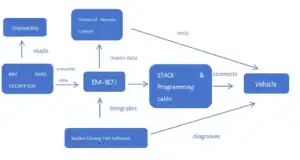
Ailyn is designed to connect these distributed endpoints into a collaborative environment in which devices can share data and capabilities according to task requirements.
Information from connected endpoints can be retrieved and used across devices instead of remaining isolated.
Different devices can participate in different stages of one workflow.
Available local compute nodes can be coordinated according to workload requirements.
Different local, industry-specific and cloud models can be managed within a more consistent AI workflow.
Unified AI Model Management
As AI deployments grow, organizations may need to work with multiple types of models rather than relying on a single large model.
Some workloads can use lightweight local models. Others may require industry-specific models or more powerful cloud-based models.
Ailyn introduces the concept of unified model management, allowing AI resources to be selected according to the task, available hardware and required computing capability.
This creates a scalable architecture in which a deployment can begin with a PC, expand to NAS or personal servers, and later add more computing nodes as application requirements increase.
Device-Edge-Cloud Collaboration
Local computing cannot replace the cloud in every situation. Larger models and more complex workloads can still require additional computing resources.
For this reason, Ailyn uses a device-edge-cloud approach rather than treating local AI and cloud AI as separate systems.
Suitable workloads can remain on local industrial computing hardware, while more complex tasks can access external models or additional computing resources.
This allows system designers to balance response time, local data processing, computing performance and deployment cost according to the application.
Where Industrial Edge AI Can Be Applied
The architecture can be applied to a wide range of industrial scenarios in which multiple endpoints and computing resources need to work together.
In
intelligent manufacturing,
industrial PCs and panel PCs can connect machine data, MES/ERP systems, AI analysis and operator interaction.
In warehouse environments, local computing devices can connect inventory systems, scanners, forklifts and other equipment. Emdoor IPC’s
warehouse management solutions
focus on these real-time industrial data workflows.
For mobile industrial operations,
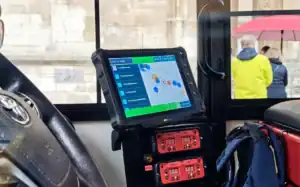
vehicle-mounted computers
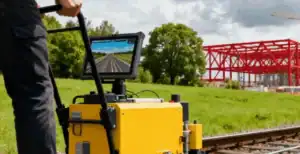
can become connected edge endpoints for forklifts, logistics fleets and transportation equipment.
Building a Scalable Industrial AI Infrastructure
The development of industrial AI is moving from isolated demonstrations toward system-level deployment.
This shift requires hardware platforms that can scale from a single endpoint to distributed computing nodes while supporting different interfaces, operating environments and application requirements.
Ailyn demonstrates one possible direction: connect endpoints, local computing resources and cloud models through a unified AI architecture, allowing industrial intelligence to expand as workloads and deployment requirements grow.
Explore Emdoor IPC
industrial computers,
panel PCs
and
vehicle computing platforms
for edge AI and industrial application development.