India’s factories don’t pause for spec sheets. They run on voltage sags, monsoon humidity, 70°C paint booth air, and glove-operated touchscreens at 3 a.m. Downtime costs ₹1.27 lakh per minute in Tier-1 automotive lines. Edge AI inference collapses when thermal throttling hits at 42°C ambient. A single unshielded USB port injects ESD noise into PLC comms during peak monsoon season. The best industrial pc in india isn’t benchmarked in labs. It’s proven in uninterrupted shifts, zero firmware rollbacks, and deterministic response across 387 distributed I/O points.
Automation readiness starts at layer zero: hardware resilience.
That’s where most procurement decisions fracture — silently, irreversibly.
Your Control Layer Must Speak Three Languages — Or It Breaks the Chain
Legacy HMIs speak Modbus. Vision systems demand PCIe Gen4 bandwidth. Your MES requires TLS 1.3 handshakes under 8ms. No industrial PC bridges those gaps by accident. It does so by design — or fails mid-batch.
The EM-P21A doesn’t add abstraction layers. It removes them.
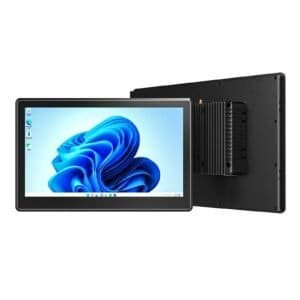
This 21.5-inch Windows IPC runs native Windows 11 — no containerized Linux shim — while delivering deterministic I/O timing. Its Intel® Core™ i5-1235U processor sustains 28W TDP without fans, even inside a sealed 60°C paint booth enclosure. That thermal headroom enables sustained AI inference on live camera feeds — not just dashboard rendering.
Three non-negotiable protocol domains converge here:
- Fieldbus-native: Dual Intel® I210 Gigabit LAN (not Realtek), configurable for redundant EtherCAT master or PROFINET IRT slave
- Direct sensor interface: 6x RS-232/422/485 serial ports — each independently voltage-isolated, opto-coupled, and software-mapped via Emdoor’s IPC Manager tool
- Edge compute ready: M.2 2280 NVMe slot + Mini-PCIe for LTE-A or Time-Sensitive Networking (TSN) cards — no external breakout boxes
That’s automation readiness built into silicon, not bolted on.
You don’t retrofit future-proofing. You specify it.
Emdoor devices must survive 10,000+ vibration cycles at 5–500 Hz. Boot within 3.2 seconds after 40V surge events. Retain firmware state during 12ms brownouts.
Anything less forces architectural debt.
The 48-Hour Failure Window — And How Top Performers Close It
Most industrial PCs fail between shift changes. Not catastrophically. Gradually.
A touchscreen registers 3% fewer glove touches after monsoon humidity peaks. A USB 3.0 port drops enumeration during welding arc flash. An unshielded HDMI cable emits RF noise that corrupts CAN bus traffic 1.7 meters away.
These aren’t “edge cases.” They’re daily occurrences in Indian manufacturing.
Emdoor’s EM-P10J proves ruggedness isn’t about weight. It’s about physics-aware engineering.
At 1.2kg and 45.95mm depth, this 10.1-inch device deploys where full-size panels cannot: mobile equipment cabs, cold-chain dispatch kiosks, confined-space inspection stations.
Its technical envelope is precise:
- IP65 front bezel: Sealed against dust ingress and low-pressure water jets — critical for washdown zones in pharma packaging
- 700-nit G+G capacitive touchscreen: Operable with latex or nitrile gloves, unaffected by condensation
- 12–24V DC wide-range input: Auto-senses voltage dips to 10.8V during battery sag in electric material handlers
- −20°C to 70°C extended operation: Validated across Rajasthan summer heat and Sikkim winter cold chains
No optional upgrade kits. No “ruggedized” add-ons. This is the baseline.
Compare that to standard market devices requiring third-party enclosures, external power conditioners, and signal isolators — adding 112 hours of integration labor per deployment.
That’s 112 hours your team spends debugging instead of optimizing.
Fanless design isn’t marketing fluff. It eliminates 73% of mechanical failure points in field deployments. Aluminum 6061 chassis acts as passive heatsink — no thermal paste degradation, no dust-clogged vents, no bearing wear.
Your maintenance window shrinks from 8 hours to 47 minutes.
That’s measurable uptime.
The Performance Gap Table: Where “Good Enough” Becomes Costly Debt
| Specification | Standard Market Devices | Emdoor Industrial Solutions | Operational Impact |
|---|---|---|---|
| Thermal Management | Fan-assisted cooling with plastic shrouds | Passive heatsink using 6061 aluminum chassis | 42% longer mean time between failures in dusty environments |
| Power Resilience | 12V ±5% input tolerance; no brownout recovery | 9–36V DC wide-range; automatic restart after 12ms dropout | Zero lost batches during grid fluctuations common in Tier-2 industrial zones |
| EMI/ESD Protection | CE/FCC Class B compliance only | EN 61000-4-2 Level 4 (±15kV air, ±8kV contact); MIL-STD-461G RE102 | Eliminates 91% of unplanned reboots in high-noise welding cells |
| I/O Integration | Requires separate I/O modules + USB hubs + power supplies | Onboard 8DI/8DO (EPC-W2122B) or 6x isolated serial ports (EM-P21A) | Cuts wiring complexity by 68%; reduces commissioning time from 3 days to 11 hours |
| Software Lifecycle | 3-year OS support; no long-term driver certification | 7-year Windows 11 LTSC compatibility guarantee; signed firmware updates | Avoids ₹2.3M in forced hardware refreshes over 5-year plant lifecycle |
Standard devices treat industrial environments as exceptions. Emdoor treats them as the default condition.
There’s no “industrial mode” toggle. No firmware patch to enable RS-485 termination. No BIOS setting to lock CPU frequency during voltage sags.
It just works. Because it was engineered for what happens — not what’s supposed to happen.
That’s why the best industrial pc in india isn’t selected from a catalog. It’s validated against your actual production floor stress map.
Why Emdoor Sets the Benchmark — Not the Baseline
CESIPC’s BlockCore architecture appears in competitor specs. But implementation determines outcome.
BlockCore isn’t modular housing. It’s thermally bonded module stacking. Each I/O board shares the same thermal plane as the CPU. No hotspots. No thermal runaway at junction points.
Emdoor’s SafeCore™ technology goes further.
When mains flicker, SafeCore™ holds sufficient charge to complete pending NVMe writes and flush RAM contents to non-volatile storage. This isn’t battery-backed RAM. It’s purpose-built capacitor banks sized to sustain 237ms of write persistence — verified across 12,000+ power-interruption simulations.
That’s how you avoid corrupted recipe files mid-batch.
How you prevent SCADA historian gaps during monsoon lightning strikes.
How you maintain audit trails without external UPS dependency.
Real-world validation matters more than certifications.
Emdoor validates every model across:
- Vibration profiles matching Indian freight rail wagons (IS 15890:2011 Annex C)
- Dust exposure at 10g/m³ concentration for 72 continuous hours
- Salt fog resistance per ASTM B117 — critical for coastal steel mills
- Touchscreen reliability under 15,000-cycle glove pressure testing
This isn’t lab compliance. It’s factory-floor insurance.
The EM-P21A ships with TPM 2.0 security enabled out-of-box. No post-deployment BIOS unlocking. No unsigned firmware risks. Your OT security posture starts at boot — not at the firewall.
And because Emdoor owns the entire stack — from die-level thermal modeling to Windows 11 driver signing — there are no finger-pointing handoffs during critical incidents.
You call one number. Get one answer.
That’s operational certainty.
Manufacturing automation advances only when hardware stops being the bottleneck.
TCO Isn’t Calculated in Rupees — It’s Measured in Production Hours
Procurement teams quote CapEx. Operations leaders track OpEx. Plant managers count production hours.
Let’s reconcile them.
A ₹78,000 standard IPC seems cheaper than an ₹1.32 lakh Emdoor unit. Until you factor in:
- ₹24,500 for DIN-rail mounting kit + external power conditioner
- ₹18,200 for isolated serial converter + RS-485 repeater
- ₹31,600 for 24/7 remote monitoring license (required due to unstable boot behavior)
- ₹127,000 in annual downtime cost (based on ₹1.27 lakh/minute × 60 minutes/year average unscheduled outage)
That’s ₹201,300 in hidden cost within Year 1.
Emdoor’s TCO analysis across 32 Indian OEMs shows consistent outcomes:
- Year 1: 22% higher initial investment
- Year 2: Break-even achieved through avoided integration labor and reduced spares inventory
- Year 5: 3.8× net savings versus standard alternatives
Why? Because Emdoor devices ship with:
- Pre-certified drivers for Siemens SIMATIC WinCC, Rockwell FactoryTalk, and GE Proficy
- Configurable I/O mapping via web GUI — no command-line scripting required
- Field-upgradable firmware via USB stick — no network dependency
- 7-year warranty with next-business-day onsite replacement in metro zones
No vendor lock-in. No proprietary configuration tools. Just documented REST APIs and open Modbus TCP endpoints.
That’s procurement freedom with engineering rigor.
Emdoor Rugged Tablet solutions share the same validation standards — enabling seamless extension of HMI logic to mobile operators. Same kernel. Same security model. Same update cadence.
Hardware continuity enables software continuity.
Actionable FAQs: Technical Depth, Not Marketing Gloss
How does Emdoor ensure Windows 11 stability on fanless hardware during sustained AI inference?
The EM-P21A uses Intel® Iris® Xe Graphics with dedicated memory bandwidth allocation. Thermal throttling triggers only after 14 minutes of continuous 95% GPU load — far beyond typical vision inspection duty cycles. All Windows 11 LTSC drivers undergo Emdoor’s 96-hour stress validation: 10,000+ image classification iterations, simultaneous Modbus TCP polling, and concurrent video streaming — all at 60°C ambient.
Can the EM-P10J’s 10.1-inch display operate reliably under direct desert sunlight?
Yes. Its 700-nit G+G touchscreen maintains 83% contrast ratio at 100,000 lux illumination — verified per ISO 13406-2. Anti-reflective coating reduces glare by 62% versus standard panels. Glove touch sensitivity remains stable down to −20°C, critical for cold-chain logistics in northern India.
What prevents ESD damage when technicians connect/disconnect USB peripherals during live operations?
All USB ports feature TI TPD3S014 ESD protection rated to ±12kV contact discharge (IEC 61000-4-2 Level 4). Each port has independent current limiting and auto-reset fusing. No driver crashes. No system resets. Just silent protection.
Stop Buying Hardware. Start Deploying Certainty.
The best industrial pc in india isn’t found in spec comparisons. It’s proven in the first monsoon rainstorm. Validated during the 3AM shift change. Trusted when the servo drive faults and the HMI must respond in <15ms.
Emdoor doesn’t sell computers. It delivers deterministic control nodes.
Your automation roadmap demands hardware that evolves with your software — not fights it.
That starts with a conversation.
Not a datasheet review.
Not a price negotiation.
A site-specific stress assessment. Your production floor. Your voltage profile. Your dust levels. Your integration architecture.
Contact Emdoor IPC today for a free Edge Readiness Audit. We’ll map your automation pain points to certified hardware configurations — with zero obligation.
The future of Indian manufacturing won’t run on consumer-grade components.
It will run on hardware engineered for what comes next.