The High-Stakes World of Transportation
The transportation industry is the lifeblood of the global economy. From cross-continental logistics to last-mile delivery, its efficiency dictates supply chain integrity, economic growth, and even daily convenience. Yet, this industry operates on a razor’s edge, facing challenges that would cripple standard consumer technology.
As you noted, operations span vast, diverse regions, battling extreme weather—from the frozen tundra to scorching deserts. The complexity of the work scope, managing fleets, cargo, and personnel across borders, creates a staggering need for unified, real-time data. Most critically, the personal safety of industry personnel is a constant, high-stakes concern.
In this environment of vibration, shock, dust, and 24/7 demand, consumer-grade laptops and tablets fail. They are a liability, not a tool. This is where the Rugged PC in Transportation Industry applications becomes not just an advantage, but an absolute necessity. These devices are the unsung heroes—the tough, reliable nerve center connecting drivers, managers, and cargo to a single, seamless data ecosystem.
The Breaking Point: Why Standard Technology Fails in Transportation
To understand the value of rugged tech, we must first appreciate the gauntlet that transportation environments throw down.
1. The War Against the Elements and Environment
The cab of a long-haul truck or the cockpit of a yard-shunting locomotive is an extreme workplace.
- Vibration & Shock: Constant engine rumble and road imperfections (potholes, rough terrain) are a death sentence for delicate components like rotating hard drives and fragile connectors.
- Extreme Temperatures: A device left in a truck cab can freeze to -30°C (-22°F) overnight or bake at 70°C (158°F) in direct sunlight. Standard batteries fail, screens crack, and processors throttle to a halt.
- Water & Dust Ingress: Rain during a delivery, humidity in a maritime port, or the pervasive dust of a warehouse (the “I” in IP rating – Ingress Protection) will short-circuit and destroy non-sealed devices.
2. The Nightmare of Disconnected & Complex Operations
You pointed to the difficulty of unified management, which stems from data silos.
- Connectivity “Deserts”: Fleets travel through remote areas with unreliable 4G/5G. A lost signal means a lost asset, a missed update, and a broken chain of custody.
- Data Inaccuracy: A driver trying to input data on a consumer tablet with gloves on, in the rain, will make mistakes. These small errors cascade, leading to incorrect inventory, missed ETAs, and compliance failures.
- Sunlight Readability: Standard screens are completely unusable in direct sunlight, forcing operators to guess, or find shade, wasting critical time during pickups and drop-offs.
3. The Human Factor: Prioritizing Worker Safety
Personal safety is paramount.
- Distracted Driving: A failing device, a lagging GPS, or a hard-to-use interface creates a dangerous distraction for drivers.
- Compliance & Fatigue: Manual logging is prone to error and makes it difficult to manage Hours of Service (HOS) regulations, increasing driver fatigue and legal risk.
- Lone Worker Dangers: For personnel inspecting rail lines or managing remote assets, a device failure cuts their only lifeline to a central command.
Defining the “Rugged” in Rugged PC: More Than Just a Tough Case
A true rugged PC isn’t a consumer tablet in a rubber case. It is engineered from the inside out to thrive in harsh conditions.
As a leading R&D and manufacturing expert in rugged hardware, Emdoor builds its industrial and in-vehicle solutions (like those on Emdoor) on this exact philosophy. It’s not just about a tough exterior; it’s about an internal architecture—from motherboard design to component selection—purpose-built to handle the specific stressors of vibration, temperature shock, and 24/7 power-on states common in transportation.
When selecting a rugged PC for the transportation industry, these are the non-negotiable features:
Core Durability (The “Must-Haves”)
- MIL-STD-810G/H Certified: This is the U.S. military standard for durability. It guarantees the device has been tested against drops (at least 4 feet), sustained shock, heavy vibration, and extreme temperature ranges.
- IP65 to IP67 Ratings: This defines its seal against the elements.
- IP65: Fully protected against dust and can withstand water jets (e.g., heavy rain).
- IP67: Fully dust-tight and can be submerged in up to 1 meter of water for 30 minutes.
Transportation-Specific Features (The “Game-Changers”)
- Sunlight-Readable Displays: These aren’t just “brighter.” They use optical bonding to reduce glare, making the screen clear even in direct, bright sunlight.
- Glove & Rain-Touch Capability: Capacitive touchscreens that are sensitive enough to register a gloved finger or wet-screen inputs, eliminating the “take gloves off” time-waster.
- Hot-Swappable Batteries: For 24/7/365 operations like warehousing and yard management, the device can’t be tethered to a charger. Hot-swappable batteries allow a user to change batteries without powering down the device, ensuring zero downtime.
- Solid-State Drives (SSDs): With no moving parts, they are inherently resistant to shock and vibration, which is critical for any in-vehicle computer.
Unbreakable Connectivity & I/O
- Advanced GNSS/GPS: Dedicated, high-sensitivity GPS modules (often with dead reckoning) provide accurate location data even in urban canyons or remote “data deserts.”
- Vehicle-Specific I/O: This is what truly separates them. Ports like CAN bus allow the PC to pull diagnostic data directly from the vehicle’s engine (telematics), while GPIO and RS-232 ports connect to legacy industrial hardware like scanners, sensors, and printers.
- Seamless Roaming: Advanced Wi-Fi and 4G/5G radios that can rapidly switch between access points (in a warehouse) or cell towers (on a highway) without dropping the connection.
Real-World Applications: The Rugged PC in Action
Rugged PCs in the transportation industry are not one-size-fits-all. They are specialized tools for specific jobs.
1. In-Vehicle Computing: The Fleet Management Hub
(Primarily: Trucking, Logistics, and Mass Transit)
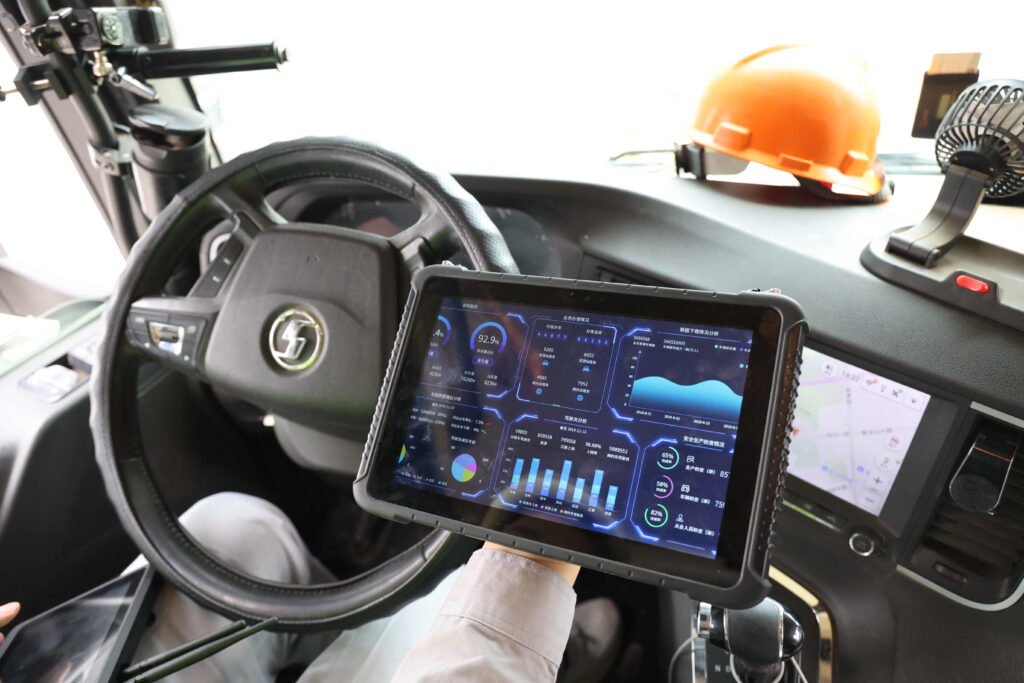
This is the domain of the in-vehicle computer or rugged vehicle-mounted terminal. These fixed-mount devices become the truck’s command center.
- Real-Time Fleet Management: They are the driver’s link to dispatch. This enables dynamic routing (avoiding traffic, weather), job-order updates, and proof-of-delivery (PoD) signature capture.
- ELD Mandate Compliance: They integrate with the engine to automate Electronic Logging Device (ELD) and Hours of Service (HOS) tracking, eliminating manual errors and ensuring legal compliance.
- Telematics and Safety: By reading the CAN bus, they monitor driver behavior (hard braking, acceleration) and vehicle health (engine temperature, fuel efficiency), enabling proactive maintenance and enhancing driver safety.
2. Warehouse & Yard Management: The Mobile Data Powerhouse
(Primarily: Warehousing, Cross-Docking, and Port Operations)
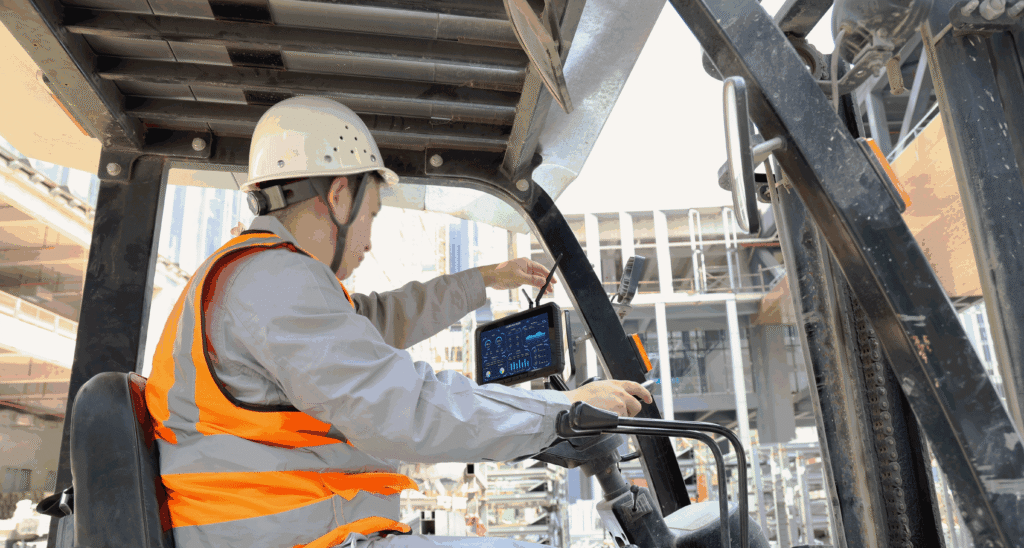
Here, rugged tablets and forklift-mounted PCs dominate. Mobility and data capture are key.
- Inventory & Asset Tracking: Integrated barcode or RFID scanners allow workers to instantly scan palettes, packages, and containers. This data is transmitted to the WMS (Warehouse Management System) in real-time, drastically reducing picking errors and lost inventory.
- Forklift Operations: A forklift-mounted PC, with a large, glove-friendly screen, gives the operator their pick-list and guides them through the warehouse, optimizing every single movement.
- Cross-Docking Efficiency: In the fast-paced cross-docking environment, rugged tablets allow for immediate identification and re-routing of inbound cargo to the correct outbound truck, minimizing storage time to near zero.
3. Rail and Maritime: The Extreme-Duty Specialists
(Primarily: Railway Maintenance, Port Authorities, and Maritime Shipping)
This segment requires the ultimate in durability.
- Railway Maintenance: Workers inspecting tracks in remote, all-weather conditions rely on rugged tablets to access schematics, log repair data, and (most importantly) maintain a safety connection to central command.
- Port Operations: Gantry crane operators use rugged PCs to manage container (TEU) movements with precision. On the ground, supervisors use tablets to log container seals and damage reports, withstanding saltwater spray and heavy impacts.
- Onboard Maritime: Rugged PCs are used for onboard navigation systems (ECDIS) and engine room monitoring, built to withstand the unique challenges of constant moisture and corrosive salt air.
The Tangible ROI: Beyond Durability, Driving Profitability
Investing in a rugged PC in the transportation industry is not an expense; it is a direct investment in profitability by reducing your Total Cost of Ownership (TCO).
- Drastically Reduced TCO: A consumer tablet might be cheap to buy, but its failure rate in the field is astronomically high. [External Link Idea: A study from VDC Research] often shows that rugged devices have a TCO that is 30-50% lower over 5 years due to reduced downtime, repair costs, and replacement cycles.
- Optimized Operational Efficiency: Real-time, accurate data eliminates guesswork. It means optimized routes (less fuel), faster turnarounds at the dock (more jobs per day), and near-perfect inventory accuracy (no lost sales).
- Enhanced Safety and Compliance: This is the ROI that’s hard to price. By automating HOS logs, you prevent costly fines and reduce accidents. By providing reliable tools, you reduce worker distraction and frustration.
- Unified Data Management: Finally, this solves your core “complexity” problem. When every driver, forklift operator, and manager is on the same data platform, you get a single source of truth for your entire operation.
The Future: IoT, AI, and the Connected Rugged PC
The role of the rugged PC is evolving. It is becoming the “edge computing” brain for the vehicle. The future of transportation isn’t just about durability; it’s about data.
- IoT Hub: The rugged PC will aggregate data from dozens of sensors—on the truck, on the cargo (cold chain), and on the driver—to provide a complete picture.
- AI-Driven Logistics: Onboard AI will use this data for predictive maintenance (“This part is likely to fail in 500 miles”) and real-time route optimization that learns from fleet-wide patterns.
Conclusion: Your Engine for a Resilient and Safe Supply Chain
The transportation industry’s challenges of extreme weather, operational complexity, and worker safety are immense. Standard technology was never built to solve them.
.Building this resilient supply chain starts with the right hardware partner. At Emdoor, our lineup of industrial PCs and in-vehicle computers featured on Emdoor are engineered to meet these exact challenges—providing the reliability to operate in any condition and the connectivity to unify your complex network.
We bridge the gap between your on-the-ground personnel and your back-office systems with technology that simply works. Contact our transportation solutions experts today to discuss how our rugged computing platforms can build a more resilient, efficient, and profitable supply chain for your business.